How Does Meditation Work? A Simple Guide for Curious Moms
Have you ever wondered, “How does meditation work?” Well, as someone with almost 30 years of experience, I’m here to give you a brief intro on how it can benefit your life as a mom.
Meditation is an ancient practice that can bring you mental clarity and calm. When you meditate, you open doors to parts of yourself that already know how to regulate your nervous system.
While it may sound distant or too challenging for busy moms, you can actually make it into whatever you’d like it to be. But like anything else, meditation takes action and commitment for you to see what it can really do for you.
Let’s find out how meditation works and how it can help you.
What is Meditation?
Definition and History
While there are many definitions of meditation, my favorite comes from the American Psychological Association. It defines meditation as,
profound and extended contemplation or reflection in order to achieve focused attention or an otherwise altered state of consciousness and to gain insight into oneself and the world. Traditionally associated with spiritual and religious exercises, meditation is now also used to provide relaxation and relief from stress; treat such symptoms as high blood pressure, pain, and insomnia; and promote overall health and well-being.
Meditation, or the act of contemplative exercise, is as old as human history. Historians say that humans have engaged in such practices as early as between 200,000 and 150,000 years ago, having contributed to the birth of symbols and language.

First written records of meditation date back to the Hindu Vedas around 1500 BCE, they note. As such, meditation has existed in virtually all cultures, the East and the West, throughout history.
The point is that meditation speaks to the human mind and development at the fundamental level. It seems inherent in the human programming, such as dreaming and emoting. See? Not so scary, right?
Types of Meditations
These days, there are many types of meditation available at our disposal. Try searching on the internet or on YouTube, and the options are plenty. And maybe confusing.
While this post cannot cover the entire universe of meditations out there, here are the major types that may be worth reviewing.
Broadly, meditation can be practiced either in complete silence or following instructions from another.
Silent Meditation Techniques
In silent meditations, a person focuses attention on their breath or something else, like sounds in the environment or a mantra.
As they notice their thoughts wander, they let them go without judgment and bring their attention back to that something. The focus is on the present moment.

Under this category, Zen meditationand Vipassana meditationcome from Buddhist traditions and are usually practiced sitting down. Zen has its roots in East Asia (Japan, Korea and China), while Vipassana’s origins go back to India.
Similar to this style is Mindfulness meditation. It covers a broader category and not linked to a religious tradition. One can practice mindfulness, or the act of constantly bringing your attention back to the present moment without judgment, with their eyes open during everyday life.
Transcendental Meditation’s technique focuses on the silent repetition of a mantra or a sound, for 20 minutes at twice a day. Transcendental meditation came from a yogi named Maharishi Mahesh, who spread this method in the United States in the 1950s.
One can also practice silent meditation during a walk or movement. During such practice, which preferably takes place in nature, one moves very slowly with their focus on the movement and the sensations it brings.
Guided Meditations
There are many, many types of guided meditations. Here are some examples:
- Body scan meditation
- Chakra meditation
- Loving kindness meditation
- Yoga Nidra meditation
- Visualization meditation
During guided meditations, someone guides you through a practice of contemplation, breath work, mantra, visualization, and so on. People who find silent meditations challenging find this style helpful, as it gives the busy mind something to do.
For guided meditations, one can find a teacher or style they like and go deeper into the practice. I am a huge fan of Dr. Joe Dispenza and his powerful meditations. And I have many available for you on YouTube that are made just for moms!
Also check out my post, 5 Best Meditations on YouTube for Healing & Spiritual Growth, for more recommendations.
Mantra Meditations
Mantra Meditations help quiet the mind by guiding it to focus on the sounds of a mantra—a word or a sound repeated to help concentration—or chanting.
A popular sound for this practice includes “Om.” Om, or “A-U-M,” is considered to be the original sound of creation and sacred in many traditions, including Hinduism and Buddhism.
To practice mantra meditation, select a word, phrase, or sound to focus on. It can be as traditional as “om” or similar Sanskrit mantras; it can also be as simple as “peace,” “loving kindness,” or “nothing.”
Get yourself into a comfortable position to be still for some time. Relax into your body, close your eyes, and repeat the sound as long as you’d like. You can say it out loud or say it silently inside your mind, or even a combination of both.
Mantra meditations have been very popular among people who find it extra difficult to quiet their minds in silence, but want the freedom to practice on their own.
RELATED POSTS:
How Does Meditation Work?
Meditation Changes Physiology
Engaging in a meditative practice allows your brain to loosen its focus away from where it wants you to go. Maybe it’s the constant list of to-dos as a mom. Maybe a troublesome relationship or constant self-criticism. More often than not, the brain just wants to go where it has been trained to go, based on past experiences and your habitual way of being (programming).
Our mind is always trying to figure it out, analyze, fight, or flee. After all, it’s a matter of survival for the ego that only wants to keep you safe.
During meditation, you notice these thoughts and emotions and gently let them go. You place your attention on something as natural as your breath, in the present moment.
Your neurons, which are communicator cells in the brain and used to firing in certain ways, suddenly have to find a different route. A detour.
Your brain lights up differently. It starts to slow down. YOU start to slow down. Your nervous systems find their balance. YOU find balance.

Scientists are increasingly measuring how meditation affects us physically.
They find that meditation changes the brain’s electrical activities to reduce stress and anxiety. They also find that meditation changes blood chemistry to improve our immune responses and modulate biological processes. Such benefits last even after meditation ends.
The more you meditate, the more you train your brain and body to a more balanced state of being.
Meditation Changes Brainwaves
In addition to mental, emotional, and physical balance, meditation helps us access different states of brainwave frequencies.
Beta frequencies, associated with stress and problem-solving, are where we spend most of our day as adults. Babies, on the other hand, remain largely in the delta brainwave states as they go back and forth between sleep and awake states.
As you can see from the graphic below, brainwave frequencies are associated with different states of consciousness.
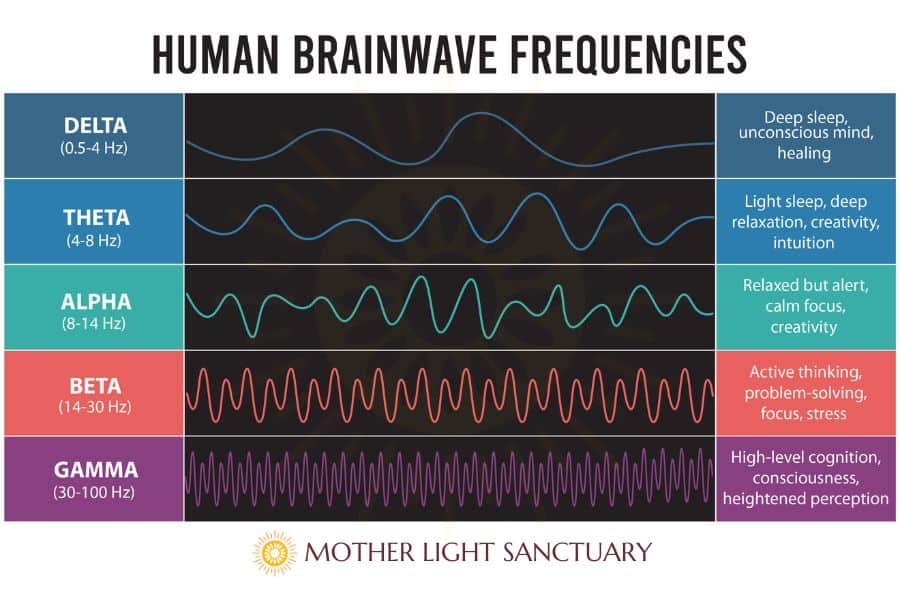
According to the Silva Method, for example, alpha brainwave states allow you to program your mind to learn anything you want, not feel pain, and achieve success.
Shamanic journeying takes place in theta brainwave states. The drum or the rattle literally sets the beat and entrains your consciousness.
Many believe that the slower your brainwave gets, the closer you get to Source. Where we all come from before birth and where we go when we pass. The quantum field from which we connect to everything and create from nothing.
Meditation is an Active Practice
I often recommend meditation to people struggling with a challenge. Sometimes, the response I get is that they basically don’t have the luxury of sitting around doing nothing.
It’s then obvious to me that they have no idea what meditation is.
Meditation is one of the most active things you can do with your mind. It requires constant presence and vigilant observation.

Meditation can be a fierce battle against yourself. To stand tall against the constant waves of your habitual thoughts and emotions requires strength.
The challenge begins the moment you decide to meditate. Will you actually make time to do it? Will you actually sit down and constantly settle your body and mind? Are you willing to let everything—the blame, the analysis, the planning, the reasoning, whatever that your mind comes up with—go, so you, the observer, can finally be free?
Meditation Brings You Joy
Hours of meditation can feel like a few moments, because you are doing SO MUCH! You’re identifying the programming that’s been running your life and making the choice to release it.
It does get easier the more you do it. It becomes like brushing your teeth. You notice the difference when you neglect or forget to do it. You are naturally inclined to make it into a routine.
Also importantly, there will be moments of amazing connection, peace, and joy that only comes when you truly let go. Meditation is your door to this state. Once you realize that this state is possible, you’ll want to get there more and more.
Meditation Releases Old Energy
Dr. Joe Dispenza has said that, every time you release an old thought or programming during meditation, stuck energy is released from the body.
The more you release, the more energy you have to use for healing and creating.
When I heard this for the first time, it was a lightbulb in my head. You see, I’d always wondered why I felt so tired at the end of the day at silent meditation retreats. I’d only sit still most of the day, walk very slowly in nature covering very short distances, and not even make eye contact with anyone. But I’d feel exhausted and ready for bed by sundown. Sleep like a rock until morning.
But the next morning would feel simply exquisite. All my senses are clear and amplified. My mind is naturally quiet. A stream of quiet joy pulses through my body.
You do not have to go to silent retreats to see this for yourself. Start somewhere, in small doses. Right where you are. That’s how my practice started almost two decades ago.
No Bad Meditations!
“There is no such thing as a bad meditation” is a Dr. Joe quote, and I agree.
There will be days when you get up from a meditation in frustration. Your mind was SO busy the entire time. You felt nothing extraordinary, and not even peaceful. You feel disappointed in yourself and are filled with doubts about the process.
But trust that it did SOMETHING.
Even if your mind did not quiet for even a moment.
I know this because I often feel energy moving/releasing during meditations, even as I’m painfully aware of my busy, distracted mind.
Do I know exactly what’s happening? No.
But I know that we are all multi-dimensional beings. Even if my physical self can’t see it, something is happening through those other layers of being.

So, don’t be discouraged if, sometimes, you feel like you failed at this. Because there is no such thing as a bad meditation.
You are giving yourself a gift EVERY TIME you do it. Whether you can see it now or not. You will see the fruits of your labor, sooner or later.
Meditation Helps You Grow
Over time, if you keep a regular meditation practice, you will notice that your life changes. Because YOU will change.
If you showed up to the world in a more relaxed and easy-going state, how would your life change? Would you have more compassion for others? Will life’s challenges seem a little more digestible?
For me, I KNOW that I stress less and less about everything that happens. My relationships have improved tremendously, especially with those closest to me. I feel that I am now living a life that most closely matches who I am, inside.
And I am finding that there is ALWAYS more to let go, more to love to embody.
Do Moms Have Time to Meditate?
I’m not gonna lie that it’s always easy to make the time. It has DEFINITELY been more challenging to meditate after having kids.
It also depends on where you are in your motherhood journey. Maybe your kids are a little bit older, and you might have 20 minutes to yourself in the evenings. Maybe your kids sleep in in the mornings, and you can squeeze in 5 minutes to focus on your breath and clear some space in your mind.

At the end of the day, your meditation practice will be whatever you make it to be. But if and when you constantly make the effort to connect to it and find the space, that’s when it’ll become tangible and alive for you.
And on some days, if you don’t get to it at all, that’s okay too! Just come back to it when you can. Make sure to count the small wins—if you were to make just three minutes, that’s three whole minutes of connection for you!
Final Thoughts
If you’re interested in learning more about the mind and how to let go, I highly recommend that you check out The Michael Singer Podcast. Singer is the author of The Untethered Soul and The Surrender Experiment. They provide amazing insights into the workings of the human mind and the Universe, as well as how life can flow if we truly let go.
Mamas! I hope this post gives you a better understanding of how meditation works and how it can benefit you. But reading is one thing. You will never really know until you TRY.
So, go TRY a quiet moment of meditation and see for yourself. And please tell me how it went for you.
This post answered the question, “How does meditation work?” I hope you enjoyed it!